Are E-Invoices Mandatory in Latvia?
In recent years, electronic invoices (e-invoices) have become one of the key drivers of business digitalization. More and more government institutions and private companies are adopting standardized electronic document exchange to reduce manual work, minimize errors, and streamline financial processes.
In this article, we'll explain when e-invoices are mandatory in Latvia, how they work, and how to prepare your business for the transition to electronic invoicing.
What Is an E-Invoice?
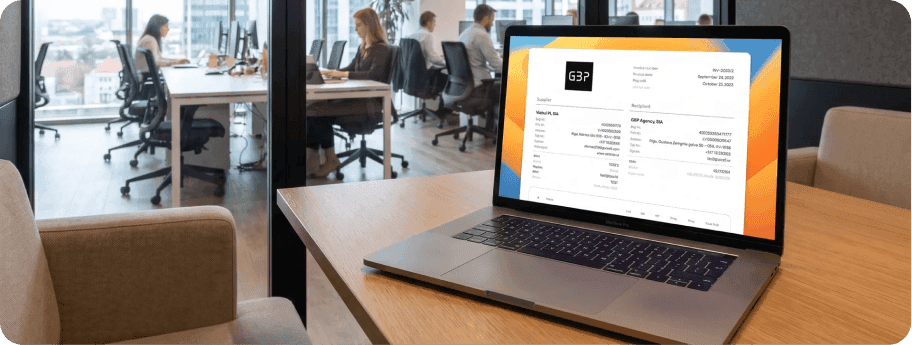
An e-invoice is not simply a PDF document sent by email.
It is a structured electronic document that can be automatically processed by business and accounting systems without manual data entry.
This means:
- Faster document processing - Fewer errors - Automatic data import - More efficient accounting
Who Is Required to Use E-Invoices in Latvia?
In certain cases, the use of e-invoices is required by law, particularly when working with government and public sector institutions.
At the same time, an increasing number of private companies are adopting e-invoices in their business relationships because they significantly reduce administrative workload.
Note: Regulatory requirements may change over time, so it is always recommended to verify the latest legal requirements.
What Are the Benefits of E-Invoices?
Using electronic invoices helps businesses:
- Reduce document processing time - Automate accounting processes - Lower printing costs - Speed up payment processing - Reduce the risk of human error - Ensure secure document archiving
XML or PDF?
Many businesses still believe that a PDF file is an e-invoice.
In reality, a PDF is only the visual representation of a document.
An XML file contains structured data that software systems can process automatically.
Automation Saves Dozens of Hours
Businesses that issue dozens or even hundreds of invoices each month can automate almost the entire invoicing process.
Automation makes it possible to:
- Generate invoices - Send invoices to customers - Track payments - Send payment reminders - Generate reports
Integration with Accounting Systems
Businesses gain the greatest benefits when their e-invoicing solution is integrated with their accounting software.
This allows them to:
- Eliminate duplicate data entry - Automatically synchronize customer information - Speed up financial processing - Reduce the risk of errors
Common Mistakes
Businesses often:
- Assume a PDF is an e-invoice - Fail to automate invoicing processes - Do not integrate with accounting software - Continue using manual document workflows - Do not use the XML format
Frequently Asked Questions
Is a PDF an e-invoice?
No. A PDF is simply the visual version of a document, whereas an e-invoice is a structured electronic document.
Do small businesses need e-invoices?
Yes. E-invoices help automate processes and reduce administrative work regardless of company size.
Can e-invoices be integrated with accounting software?
Yes.
Can e-invoices be sent automatically?
Yes.
Conclusion
E-invoices are no longer just a digitalization trend—they are becoming the standard for modern business operations. Automated invoice creation, delivery, and integration with accounting systems help reduce costs, accelerate financial processes, and improve operational efficiency.
If you're planning to implement e-invoicing in your business, explore our solutions and receive expert advice on the best implementation approach.